

Great teaching takes a team.
Teachers plan, assess, differentiate, communicate, and support students—often with limited time and resources. The work doesn’t stop when the school day ends.
Assemble your personalized EdTeam.
In addition to Liv, every EdTeam includes Dr. H, plus three AI experts you choose.
Dr. H brings the NeuraPoints language into your plans, helping you make thinking itself part of the lesson.



Every classroom is different. Choose the right content experts for your grade and subject, plus learning specialists who support daily instruction. Swap experts anytime as your needs change.
See the thinking behind every score.
A single AI assistant can summarize the scores. A team can look deeper—at what students know and how they reached their answers. Sometimes those perspectives lead to different recommendations.
With Enterprise, AI teams work across every classroom on your campus, and leaders can review class progress alongside the thinking on student canvases.


Help students make their thinking visible.
The same five-pattern language that guides your AI experts gives students a way to model their own thinking. On the NeuraPoints Canvas, they can organize ideas, compare perspectives, examine relationships, and reflect on how they reached an answer.
Liv and Dr. H help bring this language into classroom practice—so students can go beyond getting an answer right to understanding, questioning, and strengthening their reasoning.

Give every learner a place to show their thinking.
Students can visualize ideas, explore relationships, and reflect on how they learn. Liv helps teachers bring the Canvas into lessons from day one.
See how students think, not just what they know.
A traditional assessment shows what a student got right or wrong. The NeuraPoints Canvas can also reveal how the student approached the problem—how they organized ideas, made connections, and explored different perspectives.
Together, these views can help you distinguish a gap in content knowledge from an opportunity to strengthen reasoning.
See the difference between knowing and thinking.
- Identify what students may need to learn next.
- Distinguish content gaps from gaps in reasoning.
Structured learning, guided by AI experts.
Explore programs that combine purposeful activities, curriculum, and AI experts to guide learning.

Built for school from the start.
NeuraPoints runs on Pria, with account structures, guardian connections, and permissions designed to support school use.

Start with one lesson.
Plan it with Liv. Add expertise when you need it. Help your students show not just what they know, but how they think.
AI needs HI.
Thinking is the skill. Patterns drive the process. Human intelligence (HI) gives AI direction. It frames the questions, defines the problems worth solving, and challenges the answers AI produces. Without critical thinking, more AI doesn't mean more progress.
Five linking patterns.
One language for thinking.
NeuraPoints models five fundamental patterns of human thinking. Frames shape how we use those patterns, bringing the experience and perspective behind a thought into view.
On the canvas, ideas become color-coded Points that can be connected, compared, and explored through different patterns of thinking.
One AI can answer. A team can think.
NeuraPoints AI experts use the five-pattern language to examine questions from different disciplinary perspectives. They bring their reasoning into a shared, ongoing conversation, helping people uncover assumptions, explore alternatives, and make more informed decisions.




Find your starting point.
What will your AI Team work on?
Your lead sets the purpose of your team. Choose one, then add three experts. Dr. H is on every team.
Meet your new teammates.
Find the experts who fit your work. Filter by team, specialty or program, and open a profile to see how each one helps.
{{ agent.name }}
{{ agent.about }}
{{ sel.name }}
{{ sel.hook }}
Meet the crew.
Five agents guide the activities. Each is coded to the Point pattern of the activity it leads.





{{ sel.doesTitle }}
{{ sel.teachesTitle }}
{{ sel.worksTitle }}
{{ sel.works }}
NeuraPoints makes it visible.
Human thinking involves recurring cognitive processes. We compare, organize, analyze, connect, evaluate, and create meaning—often without consciously noticing how we think.
NeuraPoints brings these patterns into a single visual language. The patterns work together: one process can lead to another, several can operate at once, and their relationships can be modeled and explored.
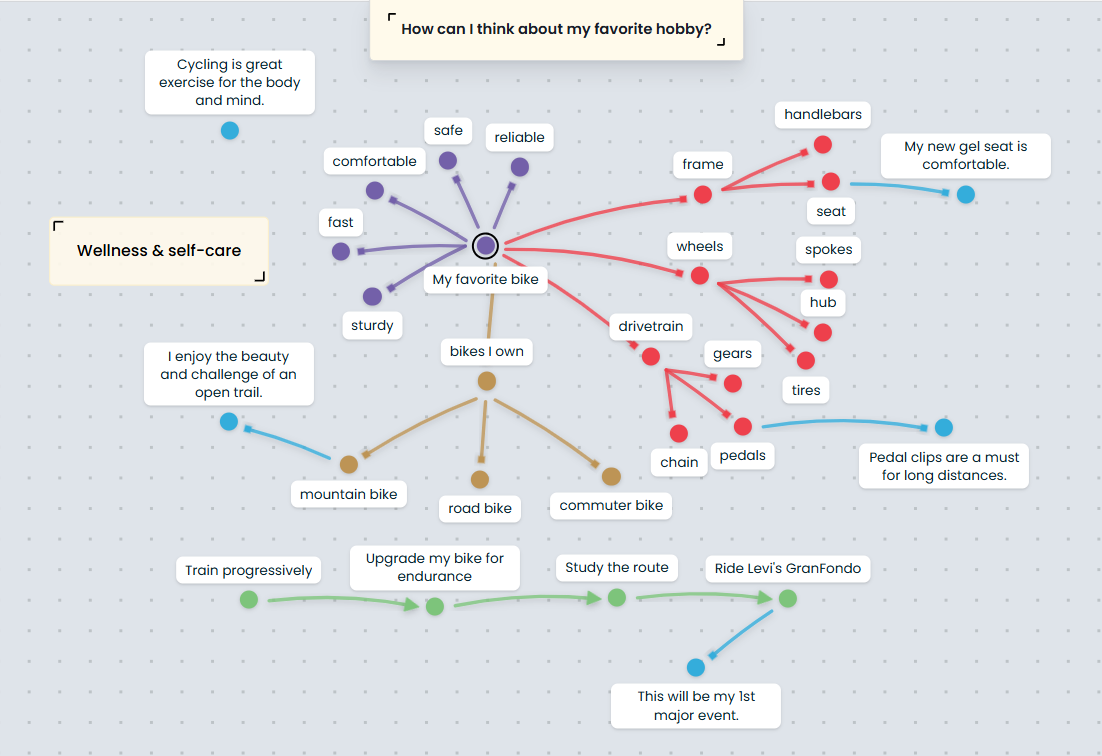
On a canvas, these relationships form a visible neuracode that reveals how thinking unfolds through processes, relationships, and context.
This makes thinking easier for people to examine and provides AI systems with a model of human cognition to work alongside human intelligence.
Five patterns describe how thinking happens.
Each pattern represents a distinct way of thinking. Together, they make it possible to explore ideas through different cognitive processes.
Exploring points of view and possibilities.
Open points, links optional
Identifying and comparing attributes.
Cluster spiraling outward
Developing concepts into categories and hierarchies.
Tree hierarchy, top-down
Analyzing sequences, causes, effects, cycles, and systems.
Flow of arrows
Examining the parts of a whole.
Bracket, left to right
Frames reveal what shapes our thinking.
A frame is a lens through which we examine something, informed by what we know, value, and assume. It directs our attention and influences how we interpret what we see.
Multiple frames can apply at once, which is why people interpret the same information differently. Making frames visible helps us question assumptions, explore other perspectives, and understand our reasoning.
Marked by corner ticks, a frame identifies the lens, context, and experience shaping the thinking inside it.
The benefits
Reasoning stops living in someone’s head. It is on the canvas, where it can be reviewed, questioned, and shared.
Because NeuraPoints models how people think, rather than how they speak, it provides a universal cognitive language across cultures.
Recognizing how different cognitive processes connect helps you choose how to approach a problem and reconsider how you reached a conclusion.
Reading the thinking
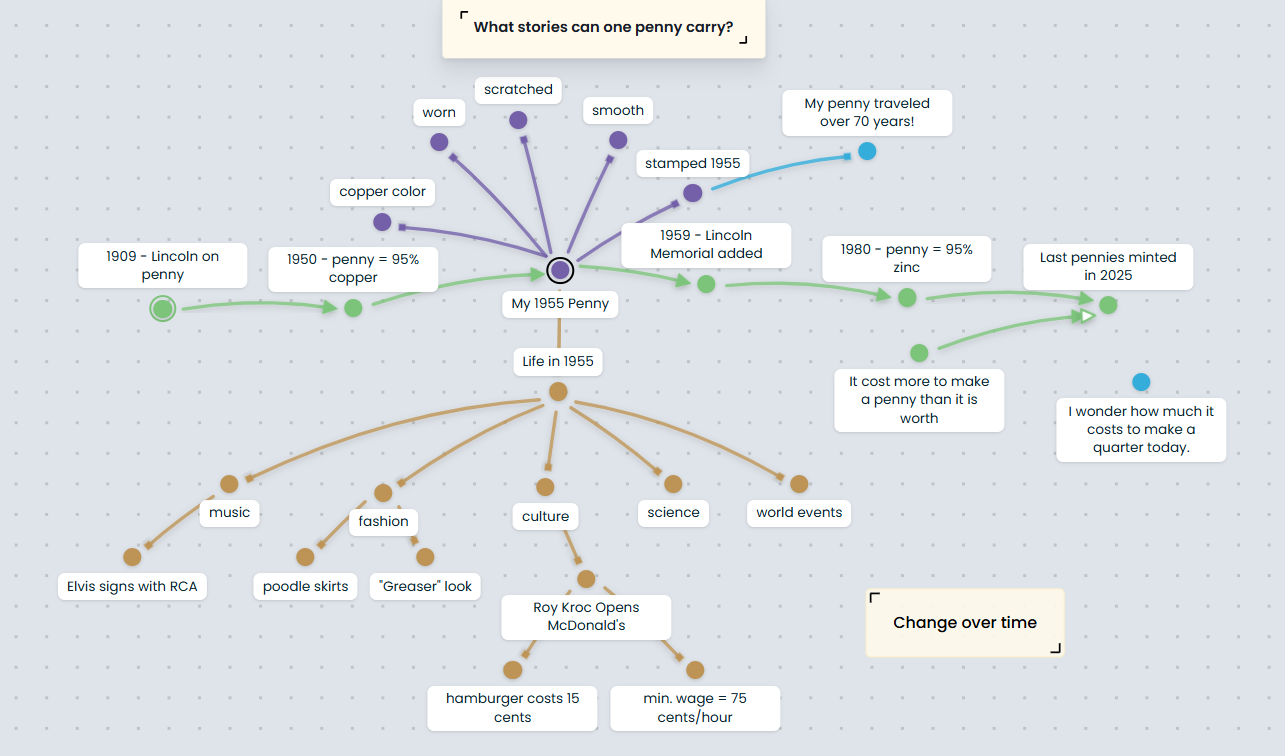
The frame at the top establishes the question: “What stories can one penny carry?” The ringed Point, “My 1955 Penny,” anchors the canvas.
CharacterPoints describe the penny's attributes, including its worn surface, scratches, and copper color. ChangePoints trace its timeline from 1909 to the last pennies minted in 2025. GroupPoints organize the music, fashion, and culture of 1955. ViewPoints capture the student's own questions and perspective.
One canvas brings these different patterns together, showing how a single subject can be explored through multiple lines of thinking.
The missing layer in AI
AI has become exceptionally good at processing information. But information alone doesn't capture the experience, context, judgment, and purpose behind human expertise.
NeuraPoints provides a way to model those elements alongside information, making the cognitive context behind human decisions visible to AI.
People bring frames shaped by their knowledge, priorities, and experience. AI experts bring distinct disciplinary perspectives. A science agent, a strategy agent, and a design agent can approach the same problem through different frames, contributing complementary perspectives to a shared conversation.
What changes when AI works this way
Most AI models learn patterns in information. NeuraPoints adds a model of the cognitive patterns, frames, and relationships through which people approach problems.
That gives AI a way to work with a person's experience and reasoning context rather than relying on a prompt alone. The goal isn't to replace human expertise, but to extend it.
Beyond prompts
A prompt tells AI what to answer.
A cognitive model shows AI how to approach the problem.
Prompts are temporary instructions. Cognitive models accumulate understanding over time.

A new relationship with intelligence
People bring experience, judgment, and purpose. AI brings additional expertise, consistency, and scale.
NeuraPoints gives them a shared cognitive foundation, extending what people can understand, decide, and create.
Get the plan that fits your needs
Common questions
{{ policyTitle }}
Last updated: October 27, 2026
1. About these Terms
These Terms of Service ("Terms") are the agreement between you and Neurapoints LLC ("NeuraPoints," "we," "us") for your use of neurapoints.com, the NeuraPoints Canvas, AI Team, the Thinking Commons, other NeuraPoints applications and products, and related services (collectively, the "NeuraPoints Services").
By creating an account, starting a trial, making a purchase, or otherwise using the NeuraPoints Services, you agree to these Terms and our Privacy Policy. If you do not agree, do not use the NeuraPoints Services.
Relationship with Pria. The NeuraPoints Services run on the Pria platform, operated by Pria LLC ("Pria"). Every NeuraPoints account is a Pria account. When you sign up for NeuraPoints, NeuraPoints adds permissions to your Pria account that give you access to NeuraPoints applications, plans, and spaces. This does not create a separate account.
Your Pria account, sign-in, and use of the Pria platform are governed by Pria's Terms of Service, Acceptable Use Policy, and Privacy Policy, which you accept when you create your Pria account. These Terms supplement those agreements with terms specific to NeuraPoints products, content, and services.
If these Terms conflict with Pria's Terms of Service, Pria's Terms control for your Pria account and the underlying platform. These Terms control for NeuraPoints products, purchases, and content, except where the conflict concerns a matter governed by Pria's platform terms. An Enterprise Agreement may establish different terms for the matters it expressly addresses.
Enterprise use. If your school, district, or organization has an Enterprise Agreement with NeuraPoints, that agreement governs your use of NeuraPoints within that deployment and controls where it conflicts with these Terms.
2. Who can use NeuraPoints
You must be located in the United States and be at least 13 years old to create your own account. If you are under the age of legal majority where you live, your parent or legal guardian must authorize your use and accept these Terms on your behalf to the extent permitted by law. A minor may not authorize purchases without the legally required adult authorization.
A child under 13 may use NeuraPoints only through a school's Enterprise deployment or as a profile reference in a parent's or legal guardian's account, as described in the Student Information Policy. Students aged 13 to 17 may hold their own accounts outside Enterprise, subject to the guardian authorization described above.
The Student Information Policy and applicable Enterprise Agreement govern the collection, use, access, and retention of student information. These Terms do not independently authorize the collection or use of student information beyond what those documents and applicable law permit.
You must provide accurate information and keep your credentials secure. You are responsible for activity you authorize under your account.
3. The NeuraPoints Services
The NeuraPoints Services include:
- NeuraPoints Canvas: A free canvas experience that includes Dr. H.
- AI Team: A paid subscription that includes a lead agent, Dr. H, three experts you choose, and Pria AI. You can add experts for an additional monthly fee.
- Other applications and products: Additional offerings described in their respective product listings.
- The Thinking Commons: A free community for sharing educational materials and other resources, as described in Section 6.
We may add, modify, or discontinue features. If we materially reduce a paid feature during a paid billing period, we will notify you. If you cancel because of that reduction, we will refund the unused portion of the affected prepaid period.
This provision does not limit any additional rights you may have under applicable law or an Enterprise Agreement.
4. Agents
NeuraPoints agents are AI systems. Each agent is identified as an AI agent by its name and role and is not a person.
Agents may retain information about your work across conversations, including after an agent is removed from your team and later added back, as described in the Privacy Policy. For students, agents retain work product and decisions rather than conversation transcripts, as described in the Student Information Policy.
AI output may be inaccurate, incomplete, or out of date. Agents may disagree with one another and recommend different approaches. You are responsible for evaluating their output and making final decisions.
Agents provide information and coaching, not legal, medical, financial, or other professional advice. They do not replace your own judgment. Do not rely on an agent as the sole basis for a decision with significant consequences for a person, including a student's grade, placement, or eligibility, without meaningful human review.
5. Your content
Ownership. "Content" means canvases, lesson materials, conversations, files, and other materials you submit to or create through the NeuraPoints Services, including output generated for you.
As between you and NeuraPoints, you retain your rights in the content you submit. Subject to third-party rights and the exclusions below, you own output created for you, and NeuraPoints assigns to you any rights it holds in that output. This does not transfer ownership of NeuraPoints materials, the NeuraPoints language, curriculum, or other intellectual property described in Section 10, or rights in third-party materials incorporated into output.
AI output may not be unique, and copyright or other intellectual property protection may not be available for all output.
License to provide the service. You grant NeuraPoints a limited, worldwide license to host, store, reproduce, process, display, and transmit your Content as reasonably necessary to provide, maintain, secure, and support the NeuraPoints Services for you and the people you choose to share it with.
Pria's rights to process your Content in operating the underlying platform are described in Pria's Terms and Privacy Policy. Each party's rights are limited to the purposes and activities described in its applicable agreements and policies.
NeuraPoints does not use your Content to train or fine-tune general-purpose AI models.
Your responsibilities. You are responsible for your Content and represent that you have the rights and permissions needed to submit it and authorize the uses described in these Terms.
Content shared in rooms or other shared spaces is subject to Pria's Terms, the applicable space or room settings, and any Enterprise Agreement. You are responsible for understanding who can access content you choose to share.
6. The Thinking Commons
You may submit lessons, canvases, and other materials to the Thinking Commons. We review submissions before publication and may decline, edit for formatting, or remove a submission.
License to NeuraPoints. By submitting materials for publication, you grant NeuraPoints a non-exclusive, worldwide, royalty-free license to publish, display, reproduce, format, distribute, and promote your submission through the Thinking Commons and NeuraPoints channels.
License to the public. You also make published submissions available under the Creative Commons Attribution-NonCommercial 4.0 International license (CC BY-NC 4.0). This public license is not limited to Thinking Commons members. It permits others to share and adapt the licensed material for noncommercial purposes, subject to the license's terms, including attribution.
The Creative Commons license applies to the material you submit and have the right to license. It does not grant rights to third-party materials that you do not own or have permission to license.
Attribution and removal. We publish your name and school with a submission only if you expressly authorize that attribution. Otherwise, attribution is to the Thinking Commons.
You may request that NeuraPoints remove a published submission. We will review the request and remove the material where appropriate. Removal does not revoke licenses already granted to others or enable us to recall copies others have downloaded or redistributed under the applicable license.
Student work. You may submit student work only with the required permissions and after removing names, faces, and other information that could identify a student. The Student Information Policy and Thinking Commons Community Guidelines also apply. Do not submit student work if you cannot confirm that the necessary permissions have been obtained.
7. Plans, trials, and billing
Prices. AI Team costs $29 per month or $278 per year. Additional experts cost $6 per month each. The price, billing frequency, and terms disclosed at checkout control your purchase.
Free trial. AI Team includes a 14-day free trial, limited to one trial per person. During the trial, your team is limited to three experts. Before you begin a trial, we will clearly disclose the price, billing frequency, trial end date, automatic conversion to a paid subscription, and cancellation method, and obtain your express consent to the recurring charge.
Unless you cancel before the trial ends, your trial converts automatically to a paid subscription and your payment method is charged. You may skip the trial and subscribe immediately.
Auto-renewal. Paid subscriptions automatically renew for the billing period you selected until canceled. By subscribing, you authorize the disclosed recurring charges to your payment method. We will provide renewal, trial, and price-change notices required by law.
Cancellation. You may cancel at any time through your subscription settings, without obstructive cancellation steps. Cancellation takes effect at the end of the current paid billing period: the current month for monthly plans or the current year for annual plans. We will provide confirmation of cancellation.
Price changes. We will give at least 30 days' notice before a renewal price changes. A new price applies no earlier than your next renewal after the notice period, subject to applicable law.
Refunds. If you cancel within 14 days of your first paid charge, you will receive a full refund. If you started with a free trial, the 14-day period begins when the trial converts to a paid subscription.
After that period:
- Monthly plans may be canceled at any time, effective at the end of the current monthly billing period. We do not refund the remainder of that month.
- Annual plans paid in full are not refundable, and your plan remains active through the end of the current annual billing period.
These rules apply to AI Team and other NeuraPoints applications and products unless a product listing expressly provides different refund terms. Fees are otherwise nonrefundable except as required by law or expressly stated in these Terms.
If we discontinue a paid plan without cause before the end of a prepaid period, we will refund the unused portion. If a material reduction in paid features triggers the refund described in Section 3, that provision also applies.
Physical products sold by other vendors are subject to the applicable vendor's return policy.
Payment and taxes. Purchases are processed through the Pria Web shop using Stripe as our payment processor. NeuraPoints is the seller and merchant of record for NeuraPoints products. When a transaction includes a product sold by another vendor, the transaction may be split, and that vendor is the seller of its product. You are responsible for applicable taxes unless the law requires otherwise.
8. Product listings
Each application or product may have a listing describing its features, price, availability, and any additional product-specific conditions. The listing forms part of these Terms for that product.
A listing may supplement these Terms or override a particular provision only when the listing clearly identifies the provision being modified and the modification is expressly stated. A listing does not override an Enterprise Agreement or Pria's platform terms unless the applicable agreement expressly permits that result.
If a listing conflicts with these Terms without clearly identifying an intended modification, these Terms control.
9. Acceptable use
You agree to follow Pria's Acceptable Use Policy, which is incorporated into these Terms. In addition, you may not:
- Extract, copy, or reproduce agent prompts, instructions, or the NeuraPoints curriculum except as these Terms expressly permit.
- Use the NeuraPoints Services or NeuraPoints-owned materials to build a competing product or train a model intended to reproduce or teach the proprietary NeuraPoints language, except as expressly authorized in writing.
- Resell or sublicense the NeuraPoints Services without our written agreement.
These restrictions do not prohibit uses expressly permitted by applicable law that cannot lawfully be restricted, or uses authorized in writing by NeuraPoints.
If we reasonably believe you have violated these Terms, we may remove content, limit features, or suspend access. Where reasonably practicable, we will provide notice and an opportunity to address the issue before taking action, unless immediate action is needed to protect users, the services, or comply with law.
10. Intellectual property
NeuraPoints and its licensors own the NeuraPoints Services, the proprietary NeuraPoints language, neuracode, curriculum and guides, and NeuraPoints marks, including NeuraPoints, ViewPoints, PartPoints, ChangePoints, GroupPoints, CharacterPoints, agent names, and character artwork, to the extent those rights are owned by NeuraPoints or its licensors.
Some materials may be used under license from third parties. Nothing in these Terms transfers ownership of third-party intellectual property to NeuraPoints or grants you rights beyond those provided by the applicable license.
Subject to these Terms and any applicable third-party license conditions, NeuraPoints grants you a limited, non-exclusive, non-transferable license to use NeuraPoints-owned materials as part of the NeuraPoints Services. You may not use NeuraPoints marks outside the scope of that license without our written permission.
Feedback. If you send us suggestions, ideas, or other feedback about the NeuraPoints Services, you grant NeuraPoints a non-exclusive, perpetual, worldwide, royalty-free right to use, reproduce, modify, and incorporate that feedback without compensation or obligation to you. Feedback does not include your private Content or personal information.
11. Third-party services
The NeuraPoints Services rely on Pria and may link to or incorporate services, resources, or materials from third parties, including Central Creativity. Those services may be subject to their own terms and privacy policies.
NeuraPoints does not control third-party services and is not responsible for their independent acts or omissions, except to the extent required by applicable law or expressly agreed in writing.
12. Suspension and termination
You may stop using the NeuraPoints Services or cancel a subscription at any time. Closing your Pria account is governed by Pria's Terms.
We may suspend or terminate your access if you violate these Terms, if reasonably necessary to protect the NeuraPoints Services or others, if required by law, or if we discontinue a service. Where reasonably practicable, we will provide notice and an opportunity to address the issue before suspension or termination.
If we terminate a paid plan without cause before the end of a prepaid period, the refund provisions in Section 7 apply.
Content and work product. When a subscription ends, work product remains in the rooms where it was created, subject to Pria's Terms, the applicable room settings, and any Enterprise Agreement. Continued storage does not necessarily mean continued access. Access may depend on your account status, permissions, subscription, and room settings.
Where supported, you should export or otherwise preserve work product you need before account closure or the loss of access. Content retention, deletion, and any available export rights are governed by the applicable Privacy Policy, Pria's Terms, and Enterprise Agreement.
Provisions that by their nature should survive termination will survive, including provisions concerning intellectual property, licenses already granted, disclaimers, liability, indemnity, and disputes.
13. Disclaimers
TO THE FULLEST EXTENT PERMITTED BY LAW, THE NEURAPOINTS SERVICES, AGENTS, CONTENT, AND OUTPUT ARE PROVIDED "AS IS" AND "AS AVAILABLE."
NEURAPOINTS DISCLAIMS ALL WARRANTIES, EXPRESS, IMPLIED, OR STATUTORY, INCLUDING WARRANTIES OF MERCHANTABILITY, FITNESS FOR A PARTICULAR PURPOSE, TITLE, AND NON-INFRINGEMENT, TO THE EXTENT PERMITTED BY LAW.
WE DO NOT WARRANT THAT THE NEURAPOINTS SERVICES OR ANY OUTPUT WILL BE ACCURATE, COMPLETE, UNINTERRUPTED, OR ERROR-FREE, OR THAT ANY PARTICULAR LEARNING OR PROFESSIONAL RESULT WILL BE ACHIEVED.
Some jurisdictions do not permit certain warranty exclusions. In those jurisdictions, these exclusions apply only to the extent permitted by applicable law.
14. Limitation of liability
TO THE FULLEST EXTENT PERMITTED BY LAW, NEURAPOINTS WILL NOT BE LIABLE FOR INDIRECT, INCIDENTAL, SPECIAL, CONSEQUENTIAL, EXEMPLARY, OR PUNITIVE DAMAGES, OR FOR LOST PROFITS, REVENUE, DATA, OR GOODWILL.
TO THE FULLEST EXTENT PERMITTED BY LAW, NEURAPOINTS' TOTAL AGGREGATE LIABILITY FOR ALL CLAIMS ARISING OUT OF OR RELATING TO THE NEURAPOINTS SERVICES OR THESE TERMS WILL NOT EXCEED THE GREATER OF (A) THE AMOUNT YOU PAID NEURAPOINTS IN THE 12 MONTHS BEFORE THE EVENT GIVING RISE TO THE CLAIM OR (B) US$100.
Nothing in these Terms excludes or limits liability that cannot lawfully be excluded or limited, including nonwaivable consumer rights and obligations that cannot be disclaimed under applicable law. Nothing in this Section excuses NeuraPoints from its express payment, refund, privacy, or security obligations.
15. Indemnity
To the extent permitted by law, you will defend and indemnify NeuraPoints against reasonable damages, costs, and attorneys' fees arising from a third-party claim, but only to the extent the claim is caused by your breach of these Terms, unlawful conduct, or infringement of another person's rights.
No indemnity applies to the extent a claim is caused by NeuraPoints' breach, negligence, or misconduct. An Enterprise Agreement's indemnity terms control where they apply.
16. Disputes
Informal resolution. Before starting arbitration or a formal legal claim, either party must give the other written notice of the dispute and 30 days to try to resolve it informally. This requirement does not prevent either party from seeking urgent relief where permitted by law.
Arbitration. Unresolved disputes will be resolved by binding individual arbitration under the Federal Arbitration Act, administered by the American Arbitration Association under its Consumer Arbitration Rules for consumer disputes and its Commercial Arbitration Rules otherwise, except where applicable law provides otherwise.
Each party may bring claims only individually and not as a class member or representative in a class, collective, or representative action, to the extent permitted by law.
Opt-out. You may opt out of arbitration and the class-action waiver by emailing [email protected] within 30 days after you first accept these Terms. Your notice must identify you and state that you wish to opt out. Opting out does not affect the remaining provisions of these Terms.
Exceptions and court proceedings. Either party may bring a qualifying claim in small-claims court in the county where you live or in Maricopa County, Arizona, subject to applicable jurisdictional requirements. Either party may also seek injunctive relief from a court where necessary to protect its intellectual property or other rights, to the extent permitted by law.
For disputes properly brought in court, the state and federal courts located in Maricopa County, Arizona, have exclusive jurisdiction, except where applicable law requires another forum.
Arizona law governs these Terms, without regard to conflict-of-law rules, except that the Federal Arbitration Act governs arbitration. Nothing in this Section limits rights that cannot lawfully be waived.
17. General
Changes to these Terms. We may change these Terms prospectively. We will give at least 30 days' notice of a material adverse change and obtain new consent where required by law. Changes will not increase fees during a paid billing period. If you do not agree to a change, you may stop using the affected services and cancel your subscription, subject to the applicable cancellation and refund terms.
Severability. If any provision of these Terms is found unenforceable, the remaining provisions will remain in effect to the extent permitted by law.
No waiver. Our failure to enforce a provision does not waive our right to enforce it later.
Assignment. You may not assign these Terms without our written consent. We may assign these Terms in connection with a merger, acquisition, corporate reorganization, or sale of assets, subject to applicable law.
Entire agreement. These Terms, Pria's incorporated terms and policies, the NeuraPoints Privacy Policy, the Student Information Policy, applicable product listings, and any applicable Enterprise Agreement constitute the agreement governing your use of the NeuraPoints Services. Where these documents conflict, the order of precedence in Section 1 applies.
18. Contact
For questions about these Terms, contact us:
Email: [email protected]
Mail: 4226 E Maplewood Ct, Gilbert, AZ 85297-4909
Website: neurapoints.com
Last updated: October 27, 2026
1. Introduction
This Privacy Policy explains what personal information Neurapoints LLC ("NeuraPoints", "we", "us") collects through neurapoints.com, the Thinking Commons, our email digest, and NeuraPoints products used in NeuraPoints spaces on the Pria platform (together, the "NeuraPoints Services"), how we use and share it, and the choices you have.
You sign in to NeuraPoints with a Pria account. Pria's Privacy Policy covers your Pria account, sign-in and Pria features outside NeuraPoints spaces.
If you use NeuraPoints through a school or district, that organization's privacy notice also applies, and our Student Information Policy explains how student information is handled.
2. Who is responsible for your information
NeuraPoints is responsible for information collected through our website, the Thinking Commons and our digest, and for information in NeuraPoints spaces, such as canvases, lesson materials, plans and purchases.
Pria operates the platform NeuraPoints runs on. For information in NeuraPoints spaces, Pria acts as our service provider under its Data Processing Agreement. Pria is responsible for the Pria account itself, including sign-in and your personal content outside NeuraPoints spaces.
Schools and districts. For information in an Enterprise deployment, the school or district controls student information. NeuraPoints contracts with the school or district and acts as its service provider. Pria supports NeuraPoints as an indirect service provider. Enterprise accounts are Pria accounts with permission to use NeuraPoints applications within the school.
3. Information we collect
Contact form. Name, email, organization, role, your message and the topic of the button you used to open the form.
Thinking Commons submissions. Name, email, school, submission type, description, any file you upload, and whether you allow us to publish your name and school.
Email digest. Your email address.
Plans and purchases. The plan and agents you choose, trial and subscription status, and transaction history. Card details go directly to our payment processor, Stripe, and are not stored by us. We receive limited information such as the last four digits and billing status.
Your content. Canvases, lesson materials, files and conversations with NeuraPoints agents, and what agents remember about your work.
Professional Development records. Program progress, PD hours and micro-credentials earned.
Student information. Only in Enterprise deployments, as described in the Student Information Policy.
Information from Pria. Your account identifier, name, email and plan status.
Collected automatically. Our website host, Netlify, records IP address, browser details and pages requested. Your browser requests our fonts from Google Fonts, which receives your IP address. The site stores the last page you viewed in your browser's local storage. The website does not set cookies or use analytics or advertising trackers. If we add analytics, we will update this policy first and, where the law requires, ask for your consent before setting non-essential cookies.
4. How we use information
- Provide the NeuraPoints Services. Run your canvases and agents, process trials and subscriptions, and deliver the PD track and Mission Control.
- Agent memory. Let agents remember your work across conversations so they can support you over time.
- Respond to you. Answer contact form messages and support requests.
- Thinking Commons. Review and publish submissions, with your name and school only if you allow it.
- Credentials. Issue micro-credentials and host their public verification links.
- Communicate. Send service notices, trial and renewal reminders, and the digest if you sign up. You can unsubscribe from the digest at any time.
- Security and improvement. Prevent abuse, fix problems and understand aggregate use.
- Legal. Comply with law and enforce our Terms.
Model training. We do not use your content, or content processed for schools, to train general-purpose AI models.
5. How we share information
- Pria, which runs the platform and the AI every agent runs on.
- Service providers that host our website and forms, process payments, send email through SendGrid, and provide the AI models Pria uses, under contracts that restrict their use of your information. Our Subprocessor list names them.
- The public. Published Thinking Commons submissions and micro-credential verification links are public.
- Your school or district, for information in its Enterprise deployment.
- Legal and safety, to comply with law or valid legal process or to protect rights and safety.
- Business transfers. If we are involved in a merger, acquisition or sale of assets, we will tell you before your information becomes subject to a different privacy policy.
- With your consent or at your direction.
If you follow our link to buy a NASA Astro Camp™ kit, Central Creativity collects your order information directly under its own privacy policy.
We do not sell your personal information, and we do not share it for cross-context behavioral advertising.
6. Agents and memory
NeuraPoints agents are AI. An agent can access only the content in the spaces it is part of. Agents remember your work across conversations, including after an agent is removed from your team and added back. Agent memory is stored in your account's namespace. When you delete your account, your namespace and the agent memory stored in it are deleted. For students, agent memory is limited as described in the Student Information Policy.
7. Children and students
NeuraPoints uses student information only in Enterprise deployments. Individual plans are not designed for student information. Our Student Information Policy explains how we handle information about children and students.
8. How long we keep information
- Account information. Governed by Pria's Privacy Policy.
- Your content. Work product remains in the rooms where it was created until you or the room's administrator delete it, including after a subscription ends. Deleted items stay in Trash for 30 days, then are purged.
- Contact form submissions. 24 months after your last message, then deleted.
- Thinking Commons submissions. Until you ask us to remove them or we unpublish them.
- Digest. Until you unsubscribe.
- Professional Development records. Set out on the PD track's product listing.
- Billing records. As required by tax and accounting law.
- Server logs. Under our website host's standard retention.
9. Security
We and our service providers use reasonable security measures designed to protect your information, including encryption in transit and at rest and access controls. No system is completely secure.
10. Your choices and rights
You can request access to, correction of, or deletion of your personal information through your account or by contacting us. Some requests may be limited by legal, security, school or shared-space requirements. We will not discriminate against you for exercising your rights. We may need to verify your identity.
California residents have rights to know, access, correct and delete personal information, obtain portable copies, limit use of sensitive personal information, opt out of sale or sharing, and be free from discrimination. NeuraPoints does not sell or share personal information as California law defines those terms.
Residents of other states with privacy laws may request access, correction, deletion and portability and opt out of targeted advertising, sale or profiling. If we deny a request, we will explain how to appeal.
We honor Global Privacy Control and other legally recognized opt-out signals where the law requires.
11. Outside the United States
NeuraPoints is offered only in the United States. If you use it from another country, your information is processed in the United States.
12. Contact us
Email: [email protected] · Mail: 4226 E Maplewood Ct, Gilbert, AZ 85297-4909 · Web: neurapoints.com, Contact
13. Changes
We may update this policy. For material changes we will give the notice required by law before the change takes effect and obtain new consent where required.
Last updated: October 28, 2026
1. Who this page is for
This page explains how NeuraPoints handles information about children and students when its services are provided through a school, district, or other organization, or when a parent or guardian authorizes a child’s use.
It supplements the NeuraPoints Privacy Policy and describes protections specific to children and students.
NeuraPoints is a tenant of Pria. Pria provides the underlying platform and processes information for NeuraPoints under their agreement. NeuraPoints is responsible for its own service, notices, and instructions to Pria. This page does not replace the Pria Privacy Policy or any applicable school, district, or organizational privacy notice.
2. Who can use NeuraPoints
- Children under 13. A child under 13 does not have a Pria account. Where supported, the child may use a Minor Profile Reference within a parent’s or guardian’s account, or use a NeuraPoints experience provided through an authorized school or organization. Required notice and parental consent or other valid legal authorization must be in place before applicable personal information is collected.
- Students under 18 without their own account. A student may be represented by a Minor Profile Reference where that experience is supported. A profile reference is a limited record within a parent’s or guardian’s account; it is not the child’s own Pria account.
- Teenagers aged 13–17. A teenager may have their own account subject to the applicable terms, required guardian authorization, and applicable law. The special no-transcript rules for Minor Profile References do not automatically apply to an ordinary teen account. Other privacy protections for children, teenagers, and students continue to apply.
NeuraPoints does not sell student personal information, use it for targeted advertising, or use it to train AI models for other users or organizations.
3. How NeuraPoints handles student information
NeuraPoints collects and uses information reasonably necessary to provide the authorized educational experience, maintain its security, and support the student’s work and learning.
Conversations and work
For a Minor Profile Reference, a conversation exists only during the active session and is not saved as a session transcript after the session ends. Authorized work product and limited decisions or inferences needed for the experience may be retained as described below.
The state of the application and the student’s authorized work product may be available to a parent, guardian, school, or organization according to their permissions. A session transcript is not provided as retained work product.
These special transcript rules do not automatically apply to ordinary accounts held by teenagers aged 13–17. Information associated with those accounts is handled under the NeuraPoints Privacy Policy, the Pria Privacy Policy, applicable agreements, and applicable law.
Information associated with a Minor Profile Reference
Depending on the experience and permissions, information may include:
- A display name or initials.
- An indicator or age band identifying the profile as a minor’s.
- A link to the parent’s or guardian’s account.
- The school or organization, plan, and seat associated with the experience.
- Enrollment, role, or other educational information provided by the school or organization.
- Student work product.
- Limited decisions and inferences needed to provide the authorized experience.
- Diagnostic and device information.
- Consent or authorization records provided by the responsible parent, guardian, school, or organization.
Information that identifies a child, or can reasonably be linked to a child, remains personal information even when it consists of decisions, inferences, or work product rather than direct identifiers.
Voice, photographs, and other media
NeuraPoints does not use photographs to create an avatar likeness of a child represented by a Minor Profile Reference. Any collection or processing of photographs, recordings, or other media must be covered by an appropriate notice, authorization, and consent where required.
Voice and other audio features may be used only as described in the applicable privacy notice and subject to any required consent. The treatment of audio and transcripts depends on the feature and account type; the special retention protections for Minor Profile References are described above.
External AI providers and computing
NeuraPoints may rely on Pria and authorized service providers to operate its features. Personal information may be processed by an external AI provider only as permitted by the applicable privacy notices, agreements, authorizations, and law. Removing direct identifiers or dividing a request into smaller parts does not, by itself, make student information anonymous.
Student personal information must not be sent to an unidentified or unauthorized recipient.
Community computing resources may receive only tasks that contain no personal information or confidential tenant content and cannot reasonably identify a child or reveal or reconstruct that information. If these conditions cannot be established, that routing is not permitted.
How student information may be used
NeuraPoints does not sell student information, use it for advertising, or use it to train AI models for other users or organizations. Student records and identifiable derivatives are not repurposed for unrelated personal profiles or agent learning.
Information may be processed as needed to provide the authorized service, maintain security, comply with law, and carry out other purposes disclosed in the applicable privacy notices and agreements.
4. Parents and guardians
Parents and guardians may request access to, correction of, or deletion of a child’s personal information, and may withdraw consent to further collection where applicable. Requests may be made through the school or organization or directly to NeuraPoints at [email protected].
NeuraPoints will verify the requester’s authority using proportionate measures and coordinate with Pria and the relevant school or organization as necessary to respond. Contacting the school or organization first may help, but does not eliminate any right that must be honored directly.
Withdrawing consent may end features that depend on the information. Once a Minor Profile Reference session ends, there is no retained session transcript to review. Retained work product, profile information, decisions, inferences, and other personal information remain subject to applicable access, correction, and deletion rights.
Information is retained only as long as necessary for the authorized purpose or a specific legal obligation, in accordance with applicable retention requirements and agreements.
5. Schools and educational organizations
Schools, districts, and other organizations that provide NeuraPoints to students must ensure that the service is used under appropriate notices, consents, authorizations, and agreements.
Where FERPA applies, NeuraPoints and Pria may handle education records on a school’s behalf only when the applicable requirements are met. A provider may qualify as a school official only where the institution establishes the required legitimate educational interest, direct control over the use and maintenance of education records, and applicable limits on use and redisclosure. If those conditions are not met, processing must be supported by appropriate consent or another lawful basis.
NeuraPoints uses student information for the educational purposes authorized by the school or organization and to provide the service. It does not use education records for advertising or to train models for other users or organizations.
Education records may be disclosed only as lawfully authorized for the service, to authorized providers subject to applicable restrictions, on the institution’s lawful instructions, or as required by law. A provider agreement alone does not establish permission for every disclosure or redisclosure.
The institution remains responsible for its obligations concerning education records. Parents and eligible students exercise applicable FERPA rights through the institution, and NeuraPoints will assist with access, correction, and lawful deletion as required by its agreements and applicable law.
Student records and identifiable derivatives are not used to create or improve unrelated personal profiles or agents.
Schools and organizations using NeuraPoints are also subject to their applicable agreement with NeuraPoints. NeuraPoints, in turn, operates on the Pria platform under its agreement with Pria.
6. Responsibilities of parents, guardians, and organizations
Parents, guardians, schools, and organizations must provide accurate information and any required notices, consents, and authorizations for the way a child or student will use NeuraPoints.
NeuraPoints and Pria each remain responsible for the privacy and legal obligations applicable to their actual roles. A contract or school authorization does not automatically transfer or eliminate an obligation imposed by law.
School authorization, where legally valid, permits only the educational use it covers. It does not authorize unrelated commercial use of a child’s information.
7. Contact
For questions or requests concerning student privacy, contact:
Email: [email protected]
Mail:
NeuraPoints LLC
4226 E Maplewood Ct
Gilbert, AZ 85297-4909
8. Changes to this page
We may update this page as our services, agreements, or legal obligations change. If a change is material, we will provide notice as required by applicable law and our agreements. The “Last updated” date identifies the current version.
Last updated: October 27, 2026
The Thinking Commons is a free community where educators share lesson starters, neuracode samples and classroom stories. These guidelines apply to everything you submit, together with the Terms of Service.
Share your own work
- Submit work you created or have the right to share. Credit co-authors and sources.
- Do not submit material from publishers, curricula or other sites without permission.
- Published submissions are licensed to other members under CC BY-NC 4.0. Others may use and adapt them for non-commercial educational purposes, with credit.
Protect students
- Submit student work only with the permission your school and the student's parent or guardian require.
- Before submitting, remove names, faces, voices, handwritten names, ID numbers and anything else that could identify a student.
- Do not describe a student in a way that could identify them, including in classroom stories.
- Never submit grades, assessment results, IEPs or other education records.
Be accurate and respectful
- Describe what happened in your classroom honestly, and label ideas you have not tried yet.
- Disagree with ideas, not people. Harassment, discrimination and personal attacks are not allowed.
- No advertising, sales pitches or affiliate links.
Work made with agents
- If an agent helped create your submission, say so.
- Check agent output for accuracy before you share it.
Review and removal
- We review every submission before publishing. We may format it for the Commons or decline it.
- We may remove published content that breaks these guidelines or the Terms of Service.
- You can ask us to remove your submission at any time. We cannot recall copies others have already downloaded.
Report a problem
If you see something that breaks these guidelines, email [email protected]. Reports about students who could be identified are reviewed first.
Last updated: October 27, 2026
These companies process personal information for NeuraPoints. Schools and districts receive at least 30 days' notice before a new subprocessor is added, consistent with Pria's DPA.
| Company | Function | Information | Location |
|---|---|---|---|
| Pria LLC | Platform: accounts, conversations, agents, storage | Account, content and student information | United States |
| Stripe, Inc. | Payment and subscription processing | Payment, billing and transaction information | United States |
| Twilio Inc. (SendGrid) | Digest, notification and service email | Email addresses, message content, delivery metadata | United States |
| Netlify, Inc. | Website hosting and contact form storage | Contact form submissions, server logs | United States |
Through Pria
Pria uses these subprocessors to run the platform NeuraPoints is built on. Pria also uses Stripe and Twilio (SendGrid). The current list is on Pria's Subprocessors page, and Pria gives at least 30 days' notice before adding or replacing one.
| Company | Function | Information | Location |
|---|---|---|---|
| Microsoft Azure | Hosting, computing and storage | Account information, content and related service data | Depends on provider, service and configuration |
| OpenAI | AI inference and response generation | Prompts, minimized conversation context and relevant content after Pria's privacy filtering | Depends on provider, service and configuration |
| Anthropic | AI inference and response generation | Prompts, minimized conversation context and relevant content after Pria's privacy filtering | Depends on provider, service and configuration |
| AI inference and response generation | Prompts, minimized conversation context and relevant content after Pria's privacy filtering | Depends on provider, service and configuration | |
| xAI (Grok API) | AI inference and response generation | Prompts, minimized conversation context and relevant content after Pria's privacy filtering | Depends on provider, service and configuration |
Other services the website uses
Google LLC (Google Fonts) delivers the site's typefaces and receives visitors' IP addresses. It does not receive account, content or student information. Hosting the fonts on our own server would remove this request.
Thinking Commons runs on WordPress that NeuraPoints hosts itself in the United States.
Central Creativity sells the NASA Astro Camp™ kit directly to buyers who follow our link. It is an independent seller, not a subprocessor.
Structured learning, guided by AI experts.
Explore programs that combine purposeful activities, curriculum, and AI experts to guide learning.
Talk to us.
Tell us what you’re working on and we’ll route your message to the right person.
Thanks, {{ cFirst }}.
Your message is on its way to our team. We’ll reply to {{ cEmail }}.